

Why Powder Consistency Matters More in Iron Powder Purchasing
Fe content is often the first specification buyers look at when purchasing iron powder. However, for manufacturers using iron powder in pressing, sintering, or other production processes, chemical composition is only one part of the picture.
Two iron powders with similar chemical compositions can behave differently during production. Differences in particle size distribution, particle morphology, apparent density, flowability, and batch consistency can all affect processing performance and the quality of the final product.
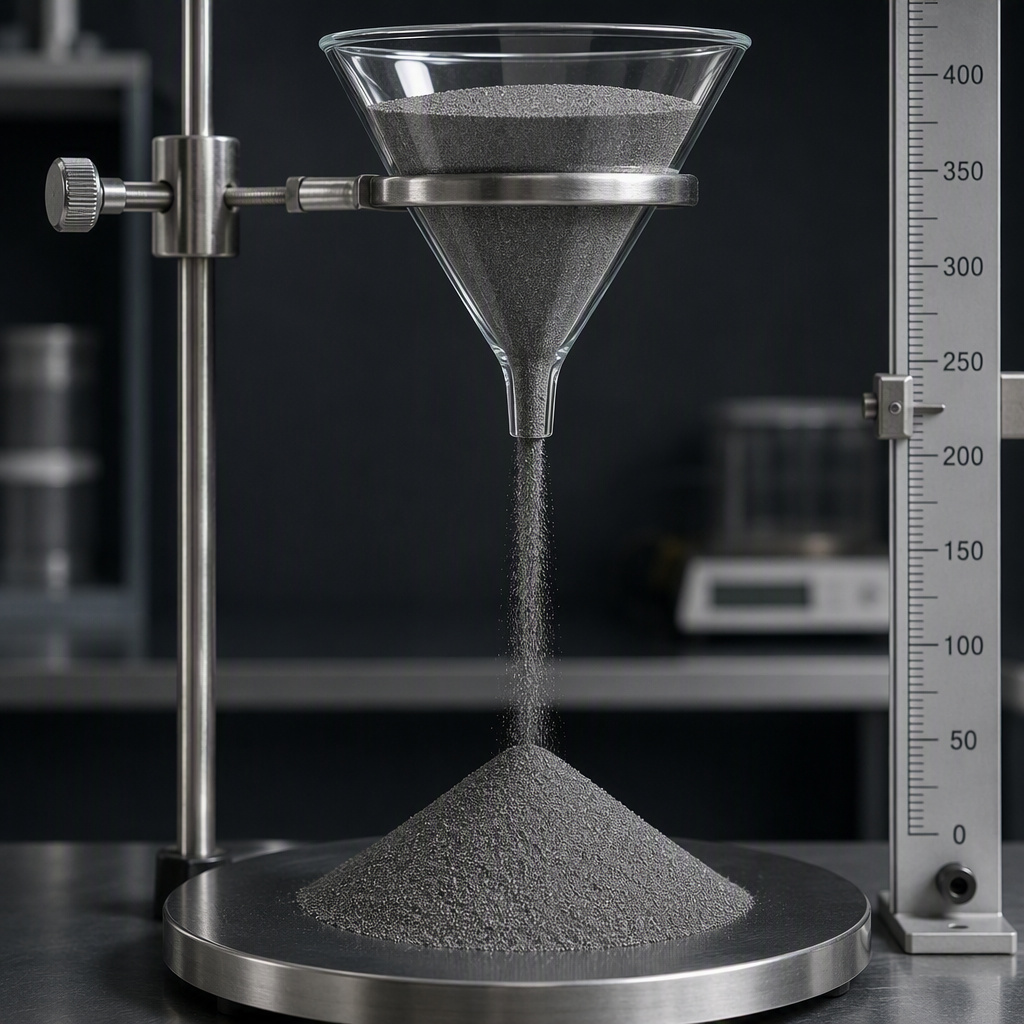
Chemical Composition Is Only the Starting Point
Chemical composition remains a basic requirement for iron powder selection.
Carbon, oxygen, sulfur, phosphorus, and other elements can affect powder processing and the properties of the finished component.
However, meeting the required chemical specifications does not necessarily mean that a powder will perform well on a customer's production line.
In pressing and sintering applications, the powder needs to fill the die consistently and form a compact with the required density and strength. For this reason, physical properties are just as important as chemical composition in many applications.
Particle Size Distribution
Particle size distribution is one of the key characteristics of iron powder.
The size and distribution of particles affect how the powder packs and flows during die filling and compaction. An appropriate particle size distribution can help improve filling behavior and achieve the required green density.
Different applications also require different particle size ranges. A finer powder is not necessarily better, and a coarser powder is not necessarily more suitable.
The right particle size is the one that works for the customer's process.
This is why particle size distribution should be evaluated together with the actual processing requirements rather than considered as an isolated specification.
Apparent Density and Flowability
Apparent density is another important parameter in powder metallurgy.
During automated pressing, iron powder needs to enter and fill the die in a stable and repeatable manner. Significant changes in apparent density from one batch to another can affect the amount of powder entering the die and, consequently, the weight and dimensions of the compact.
Flowability is closely related to this process.
Good flowability supports stable powder feeding and die filling, which is particularly important for automated and high-volume production.
Batch-to-Batch Consistency
For long-term industrial customers, consistency between batches can be more important than the performance of a single batch.
A powder may produce good results during initial testing, but if the characteristics change significantly in subsequent batches, the customer may need to adjust the production process repeatedly.
This can increase costs related to:
· Production adjustments
· Quality control
· Scrap
· Additional testing
· Process development
For this reason, experienced industrial buyers often ask a simple question:
Can the supplier consistently reproduce the same powder properties over time?
A reliable supply is not simply about having sufficient production capacity. It is also about maintaining stable product characteristics from batch to batch.
Water-Atomized Iron Powder and Process Consistency
Water-atomized iron powder remains an important material for high-volume industrial applications.
The process can be controlled through raw material selection, melting conditions, atomization parameters, screening, and classification. These factors can be adjusted to achieve the required particle size distribution, apparent density, and other physical properties.
This means that water atomization should not be viewed simply as a low-cost production method. With appropriate process control, water-atomized powders can be developed for specific industrial requirements.
What Should Buyers Ask Their Suppliers?
For long-term iron powder purchasing, buyers may want to look beyond Fe content and nominal particle size.
Important questions include:
1. What is the particle size distribution?
2. What is the apparent density?
3. How is flowability measured?
4. What are the carbon and oxygen levels?
5. How consistent are the properties between batches?
6. What quality control procedures are used?
7. What production capacity is available?
8. Can the supplier provide application or pressing test data?
For powder metallurgy applications, actual pressing and sintering data can also provide useful information about how a powder is likely to perform in production.
A detailed COA is important, but it does not always tell the complete story.
Consistency Is Part of Product Quality
As iron powder applications become more demanding, product consistency is becoming an increasingly important part of supplier selection.
For manufacturers, stable particle size distribution, apparent density, flowability, chemical composition, and batch-to-batch performance can help reduce process adjustments and maintain stable production.
For suppliers, the challenge is therefore not simply to produce iron powder that meets a specification once.
The greater challenge is to produce the same quality consistently, shipment after shipment.
For many industrial applications, that consistency is what turns a powder supplier into a reliable long-term partner.