

CSIRO Opens Advanced Powder Lab to Support the Future of Metal Manufacturing
Australia's national science agency, the Commonwealth Scientific and Industrial Research Organisation (CSIRO), has commissioned a new Powder Lab at its Clayton site in Melbourne. Announced on September 16, 2026, the facility is designed to help industry develop, process and characterise advanced metal powders for additive manufacturing and powder metallurgy.
The laboratory provides access to specialised equipment for modifying particle shape, combining materials and developing powder feedstocks tailored to specific manufacturing requirements. The initiative reflects a broader industry focus on improving powder performance, expanding material options and bringing advanced materials research closer to industrial production.
Source: CSIRO, “From powder to possibility: CSIRO’s new lab is helping shape the future of metal 3D printing,” September 16, 2026.
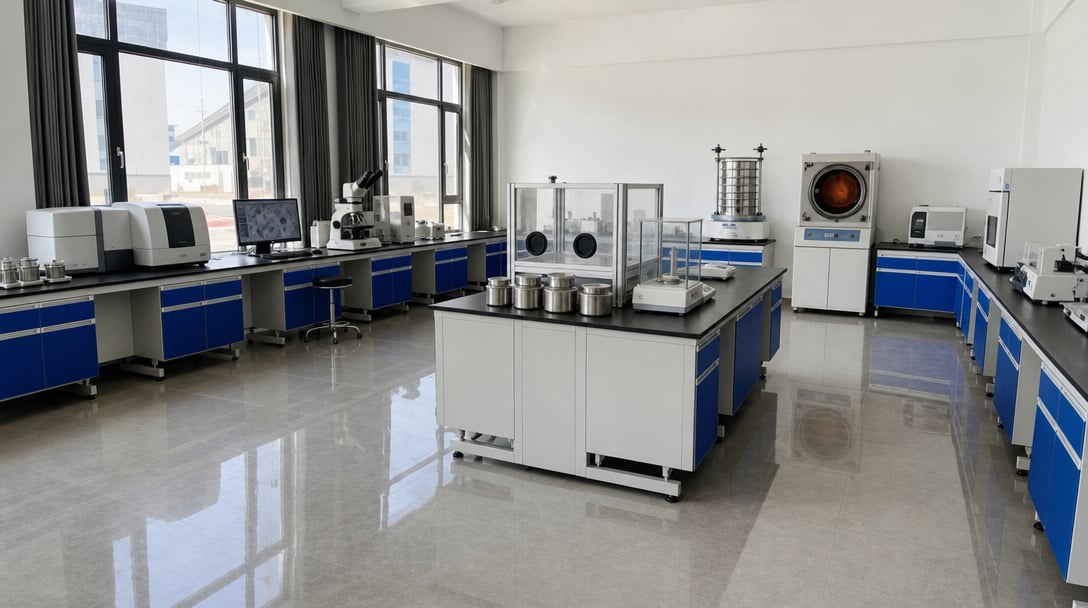
Advanced Powder Processing and Characterisation
According to CSIRO, the new facility includes two key technologies.
The first is a plasma-based powder spheroidisation system, which uses high-temperature radio-frequency plasma to reshape irregular particles into more spherical forms. The second is a powder hybridisation mill, designed to coat or combine different materials at a microscopic level.
These technologies allow researchers to investigate how powder characteristics can be adjusted to meet specific application requirements. They also support the development of specialised feedstocks for additive manufacturing, powder metallurgy and emerging composite materials.
For powder-based manufacturing, particle characteristics are closely connected to processing performance. Depending on the application, important considerations may include particle size distribution, morphology, flowability, apparent density, chemical composition and consistency.
Why Powder Quality Matters in Manufacturing
Metal powders are not simply raw materials. Their properties can affect the efficiency and reliability of downstream manufacturing processes.
In conventional powder metallurgy, iron powder selection can influence die filling, compactibility, green strength and the performance of pressed and sintered components. Powder characteristics must be evaluated alongside the selected lubricant, alloying system, compaction conditions and sintering process.
For metal additive manufacturing, the requirements differ according to the printing technology. Particle size distribution, morphology, flowability and chemical composition can affect powder feeding, layer deposition and processing stability. The appropriate specifications depend on the equipment, process parameters and intended component.
This is why powder evaluation should be application-specific rather than based on a single performance indicator.
Customised Feedstocks and Material Development
CSIRO's new facility also highlights growing interest in customised powder feedstocks. Manufacturers increasingly need materials designed around particular production processes and product requirements, rather than relying exclusively on standard commercial grades.
This development creates opportunities for collaboration between powder producers, research organisations, equipment manufacturers and component makers. By connecting powder development with testing and prototype manufacturing, the industry can better evaluate whether a material is suitable for its intended use.
For industrial buyers, however, new processing technologies do not eliminate the need for clear material specifications and quality verification. Chemical composition, particle characteristics and process compatibility remain essential when qualifying a new powder.
Implications for Iron Powder and Stainless Steel Powder Buyers
Developments in advanced powder research are relevant beyond additive manufacturing alone. They reinforce the importance of understanding how powder properties relate to different manufacturing processes.
For conventional powder metallurgy, buyers may prioritise compressibility, green strength, apparent density and consistent performance during compaction and sintering. For stainless steel powders used in additive manufacturing, particle morphology, size distribution, flowability and chemistry may require particular attention.
At Shanghai Knowhow Powder-Tech Co., Ltd. (KPT), our product focus includes water-atomised iron powder, reduced iron powder, iron-based alloy powder and stainless steel powder for industrial applications.
As metal powder technologies continue to evolve, understanding the relationship between material specifications and end-use requirements remains an important part of powder selection. Working from clear technical requirements and verified material data helps manufacturers identify powders appropriate for their production processes.
The future of metal manufacturing depends not only on processing equipment, but also on the quality, consistency and suitability of the powders used to produce each component.