

Beyond Hydrogen and Lithium—The Rise of Metal Fuels
As the global industrial sector accelerates its transition toward Net-Zero, the search for energy carriers that combine high density, long-term storage safety, and zero lifecycle emissions has intensified. While hydrogen and lithium-ion batteries dominate the headlines, a groundbreaking contender is returning to the spotlight: Metal Iron Powder.
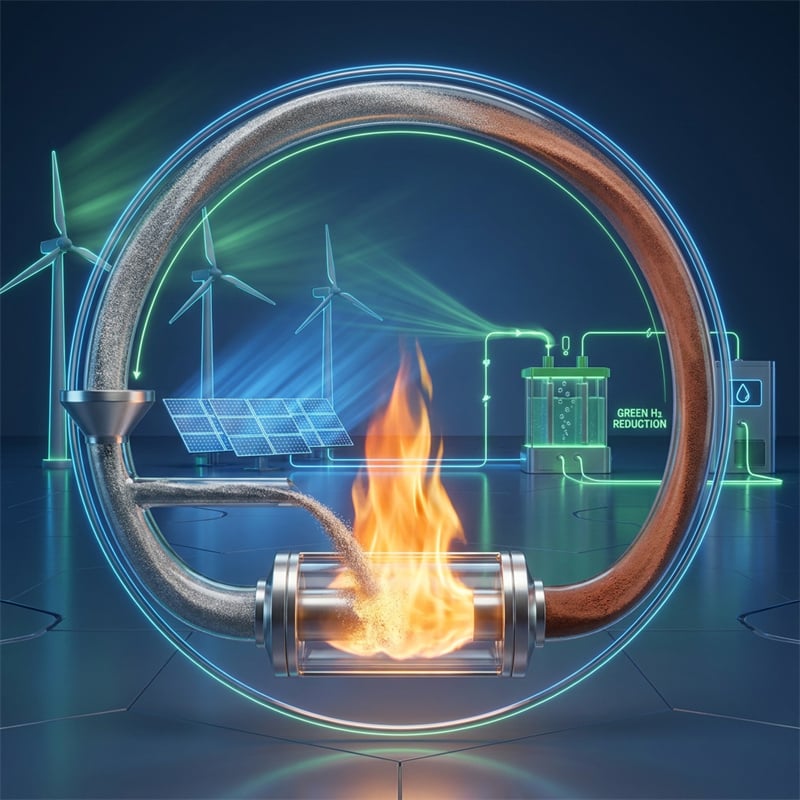
The logic of iron energy is elegant and circular: iron acts as a medium for energy storage, releasing intense thermal energy through oxidative combustion, and is then "recharged" back into iron powder via reduction with green hydrogen. This "Iron—Iron Oxide—Iron" closed-loop system offers a scalable solution for industrial heating and seasonal energy storage.
I. Energy-Grade Iron Powder: The Foundation of the Supply Chain
Not all iron powder is suitable for energy use. Unlike traditional metallurgy, Energy-Grade Iron Powder must meet rigorous standards: purity ≥98%, specific particle size (20–100μm), and high reactivity. Currently, three primary production pathways are shaping the global supply chain:
Iron Ore Concentrate Reduction (Scalable Baseline): High-grade iron ore is purified and reduced using green hydrogen at 600–900°C to create porous sponge iron. This is the most cost-competitive route for large-scale industrial applications.
Scrap Metal Recycling (Low-Carbon Loop): High-quality steel scrap is melted and atomized using high-pressure gas or water. This path has the lowest carbon footprint and fits perfectly within the ESG (Environmental, Social, and Governance) frameworks of modern enterprises.
Chemical Synthesis (Premium Customization): Through the thermal decomposition of compounds like carbonyl iron, ultra-fine or nano-scale powders are produced. These offer extreme reactivity and combustion rates, ideal for specialized high-precision energy devices.
II. High-Efficiency Combustion: 1500°C Zero-Carbon Heat
Iron powder is rapidly becoming a "clean substitute" for coal and gas-fired boilers. Through precision pneumatic conveying and closed-loop feeding systems, iron powder is mixed with preheated air and ignited.
Intense Heat: Combustion temperatures reach 1200–1500°C, generating high-temperature flue gas for steam turbines or direct industrial processing.
Zero Emissions: The process is entirely free of CO2 and SOx. The only byproduct is solid iron oxide (rust) dust, which is 100% captured via baghouse filters.
Safety & Stability: Unlike volatile hydrogen, iron powder is stable at room temperature, has no evaporation loss, and poses zero explosion risk during long-term storage.
III. The Energy Logic: Cross-Temporal Energy Transport
The commercial brilliance of iron energy lies in its "Infinite Circularity." It functions essentially as a "Solid-State Battery":
The "Charge" Phase: When wind or solar energy is abundant, low-cost green electricity is used to produce hydrogen, which reduces iron oxide back into metal iron powder, effectively "storing" the energy in chemical form.
The "Discharge" Phase: During peak demand or winter months, the iron powder is burned to release heat on demand.
While the current Round-Trip Efficiency (RTE) ranges between 35% and 50%, iron powder excels in seasonal storage and cross-regional transport, where the cost of lithium-ion batteries or hydrogen pipelines becomes prohibitive.